Mental Capital: Protect Your Attention
Every CEO I know is chasing time. They want more hours, more focus, more space to think. But the real constraint isn’t time, it’s attention. You can’t scale your company faster than you can manage your focus. When your attention gets fragmented, so does the business.
Mental capital is your most valuable asset. It’s the sum of your clarity, judgment, and creative energy. When it’s high, you see things others can’t. When it’s low, everything feels harder than it should. And unlike cash, you can’t borrow more of it. You have to protect it.
The problem is most leaders run their days like open tabs in a browser. Every ping, every meeting, every message competes for their mental bandwidth. They confuse responsiveness with leadership and burn clarity in the process. At some point, they wake up exhausted. Not because they worked too hard, but because they gave their attention to everything except what mattered most.
Here’s what protecting your attention actually looks like:
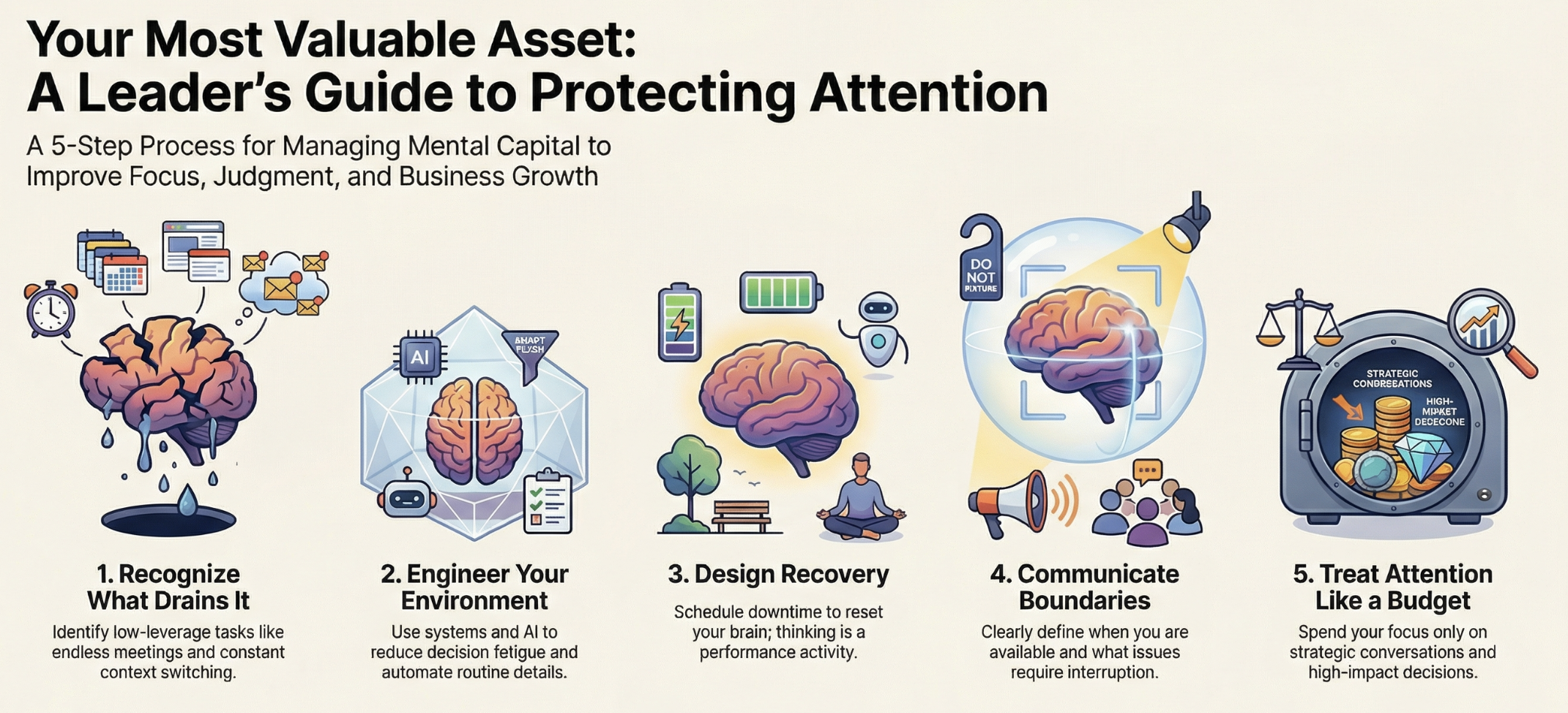
Start by recognizing what drains it. Endless meetings. Constant context switching. Staying too close to problems your team can handle. Every time you engage with low-leverage work, you’re burning high-leverage energy. Track the moments in your week when your mind feels scattered or your body tenses up. Those are clues.
Next, take ownership of your environment. Attention doesn’t survive by accident—it’s engineered. Build systems that reduce decision fatigue. Use AI to prep summaries, draft notes, and handle details that don’t require your judgment. It’s not about outsourcing thinking—it’s about protecting the parts of thinking that create the most value.
Design recovery into your rhythm. Thinking is a performance activity, not an endurance sport. Step away long enough for your brain to reset. The best CEOs I know schedule downtime the way others schedule meetings. They understand that space isn’t wasted time. It’s where you can recognize patterns.
Communicate boundaries clearly. Protecting attention only works when your team knows the rules. Tell them when you’re available, what kind of issues deserve interruption, and what decisions they can make without you. Boundaries create clarity.
Finally, treat your attention like a budget. Spend it where it compounds. Every strategic conversation, every customer insight, every big decision should earn the right to your focus. The rest belongs to systems, structure, and people you trust.
You can tell a lot about a company by how its CEO manages attention. If the leader is scattered, the team is reactive. If the leader is clear, the team is confident. Leadership energy flows downhill.
If you’re feeling stretched thin, don’t chase more hours. Audit where your attention goes. Reclaim the parts that move the business forward. Let the rest fall away.
Your mind is the operating system of the company. If you keep it clean, fast, and uncluttered, growth stops feeling like strain. It starts feeling like momentum.