I usually hear the word scaling right after a leader says something like, “Nothing is technically wrong, but this feels harder than it should.” Revenue is still growing, the team is smart, and there isn’t a single fire that explains why decisions keep circling or why they’re still pulled into work they thought they’d be out of by now.
What they’re reacting to isn’t growth itself. It’s the quiet accumulation of things they’ve learned to compensate for without ever deciding whether those compensations should still exist.
That’s the point where scaling becomes interesting to me.
I don’t think about scaling as growth in the way it’s usually discussed. I think about it as what happens when a business outgrows the informal agreements, assumptions, and workarounds that once made it move faster. Over time, those adaptations stop being helpful and start shaping how decisions get made, how energy moves, and where leaders get stuck without realizing it.
Where scaling actually slows down
Most companies don’t stall because they chose the wrong strategy. They stall because execution starts absorbing more leadership attention than anyone expected, and it quietly becomes normal for leaders to be involved in places they assumed they’d have exited by now.
You can see it in decisions that should be straightforward but somehow require multiple conversations to land, even when the people involved trust each other and generally agree. You see it in priorities that sound clear in a meeting but fracture once teams act on them and discover they were operating from different interpretations. And you see it most clearly in leaders who are still personally resolving issues the organization should already be capable of handling on its own.
None of this looks dramatic. It just feels busy, slightly inefficient, and strangely expensive.
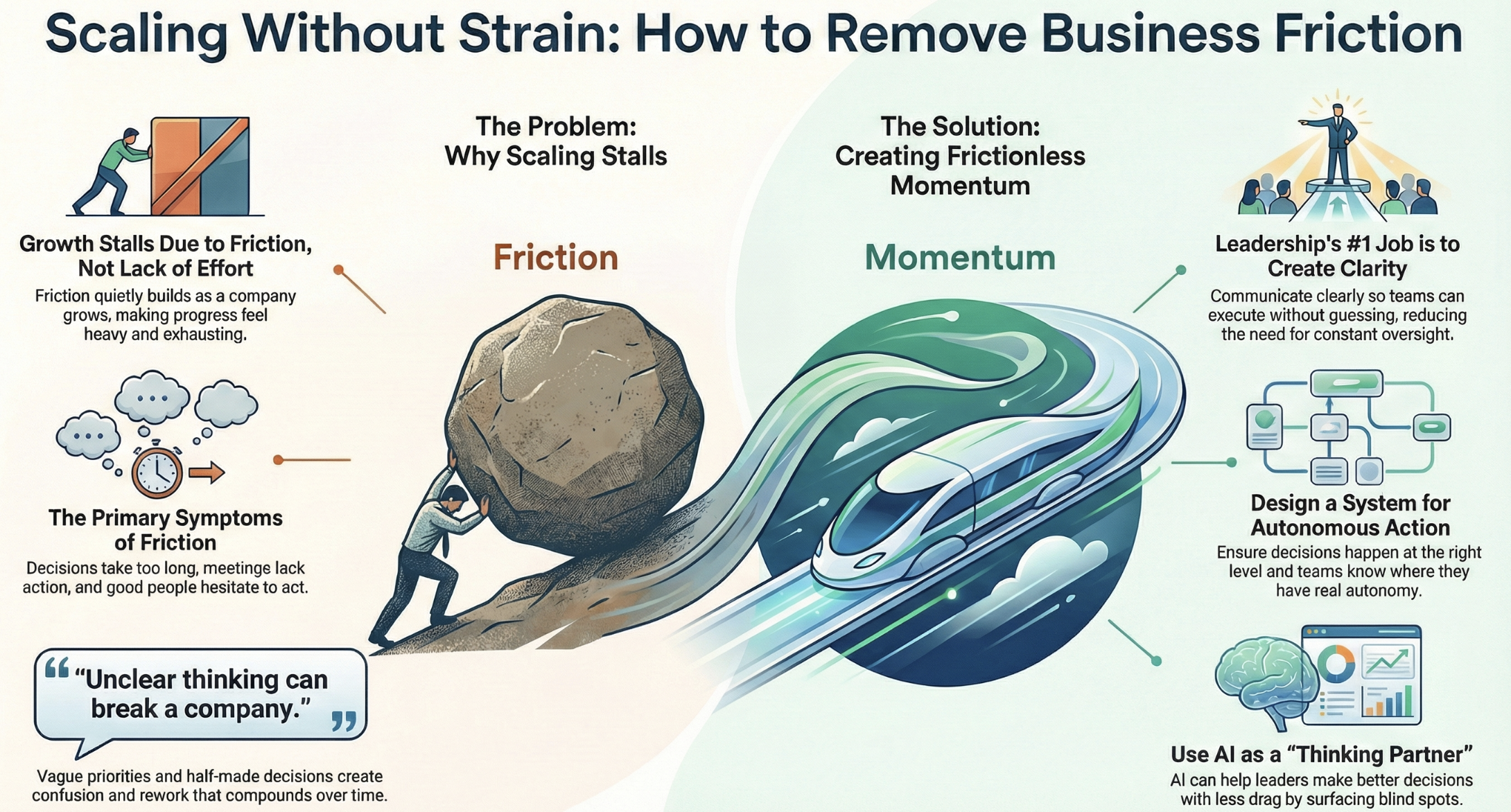
At first, leaders compensate almost automatically. They clarify things in the moment. They stay closer to decisions. They fill the gaps so work can keep moving. On some level, they know they’re doing it, but it still feels responsible, even necessary.
For a while, that type of adjustment works.
Then it doesn’t, and by the time it becomes obvious, the company has already organized itself around that extra effort.
The issue usually isn’t capacity
When scaling becomes difficult, it’s tempting to frame the problem as capacity. Not enough time. Not enough leverage. Not enough people who can operate independently. But most of the time, capacity isn’t the real constraint. Clarity is.
Not clarity as a slogan, but clarity as a design decision. Who actually owns which decisions. What truly matters right now versus what just sounds important. Which tradeoffs are being made quietly because slowing down to name them feels risky.
When those things are unclear, the company compensates in predictable ways. Meetings multiply. Alignment becomes a recurring topic. Decisions drift up the ladder because no one is completely confident where the edges are. Leaders become the default answer, not because they want control, but because the system still depends on them to make things clear.
What’s striking is how quickly the dynamic shifts once the real ambiguity is named. Energy returns without anyone needing to be motivated. Decisions move without adding process. People stop checking in constantly because they finally understand the boundary they’re operating inside.
Nothing magical happens. The system just stops asking people to compensate.
Scaling is a design problem before it’s a leadership problem
As companies grow, CEOs sometimes find themselves holding on tighter, even when they know it isn’t sustainable. From the outside, that can look like a control issue. From the inside, it usually feels like responsibility.
The organization still relies on them to connect dots, resolve tension, and make judgment calls that were never fully designed into the structure. So they stay involved, even as it costs them focus and thinking space.
Healthy scaling doesn’t mean CEOs disappear from decisions. It means decisions stop depending on them as the connective tissue. Accountability becomes clearer. Ownership moves closer to the work. Progress doesn’t hinge on who happens to be available to interpret things in real time.
When CEOs stop being the workaround, the company starts behaving more like an organization and less like a group of capable people waiting for alignment.
Where AI actually becomes valuable
AI only matters in scaling when it forces clearer thinking.
I’m not interested in it as a shortcut or a way to move faster for the sake of speed. I’m interested in it as a mirror. Used well, it exposes assumptions leaders didn’t realize they were making and surfaces inconsistencies that were previously absorbed by experience, judgment, and extra effort.
It makes judgement visible versus replacing it.
When AI is used poorly it just adds another layer of activity and noise. When it’s used intentionally, it compresses the time between insight and decision because it doesn’t let vague thinking hide for very long.
The leverage comes from better questions, not better answers.
When growth feels heavy
When scaling is working, the business actually feels lighter as it gets bigger. CEOs have more space to think. Teams spend less time interpreting and more time executing. Decisions move without needing to be carried.
When growth feels exhausting, it’s tempting to assume the answer is more discipline, more effort, or more structure layered on top of what already exists. Sometimes that helps in the short term. More often, it just hides the real issue a little longer.
The harder move is to look at what’s been normalized, especially the ways leaders have stayed involved not because it’s strategic, but because the system still needs them to be. That’s uncomfortable to see clearly, and even more uncomfortable to redesign.
Most companies don’t get stuck because they lack momentum. They get stuck because they’re still carrying things they never stopped to question.
And until that changes, growth will keep feeling heavier than it should, even when everything else looks like it’s working.