I didn’t change how I work because I wanted to be busier or more efficient. I changed how I work because I wanted to be more useful at the level my clients actually need me.
As my coaching practice grew, I started to notice a quiet mismatch between where I created the most value and where I was spending a meaningful amount of my time. On the surface, my weeks looked full and productive, but underneath that fullness were hours tied up in tasks that didn’t require my judgment, perspective, or experience as a coach. They simply required attention.
So I did something simple and uncomfortable. I tracked my time honestly for a few weeks and looked at it without justification. What showed up was about ten hours a week spent on work that supported the business but didn’t advance the outcomes my clients were paying for. Scheduling, preparing agendas, cleaning up notes, writing summaries, organizing follow ups, and reworking calendars had quietly become part of my identity as a “good coach,” even though none of that was where my highest leverage lived.
That realization wasn’t about working less. It was about taking responsibility for how my time was being used.
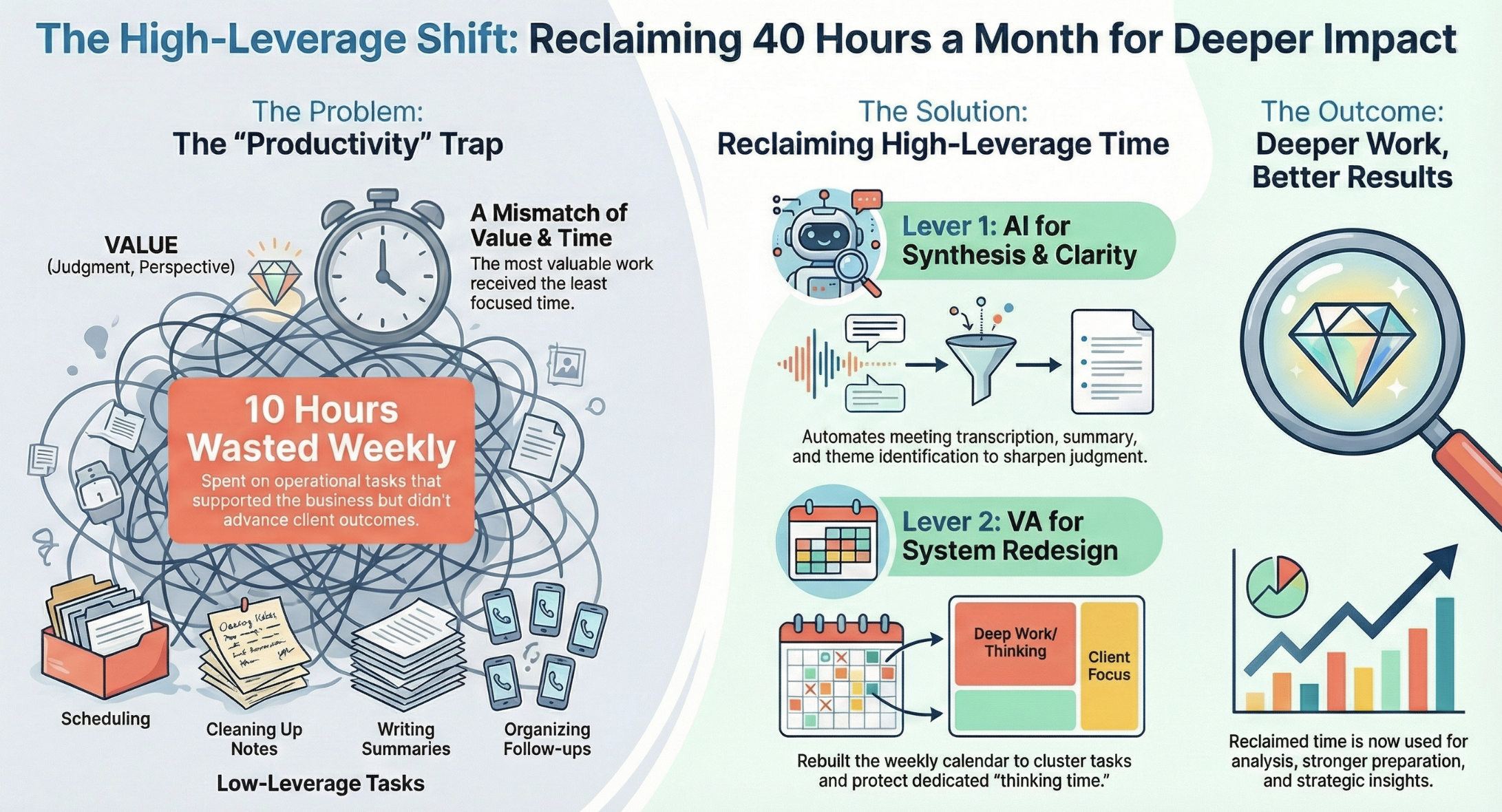
Once I could see that those ten hours a week were mostly operational, the question became what I was going to do with the forty hours a month they represented. I didn’t replace that time with more calls or more volume. I replaced it with thinking, synthesis, and deeper preparation for the moments that actually change outcomes for CEOs and leadership teams.
AI became the first lever. Every meeting I facilitate or coach is recorded, transcribed, and organized automatically, which means I’m no longer relying on memory or fragmented notes to spot patterns. AI helps me prepare before sessions by reviewing prior conversations, surfacing themes, and identifying unresolved tensions, and it helps me after sessions by summarizing decisions, highlighting risks, and capturing commitments without me needing to touch a keyboard.
What made this truly strategic was building an AI layer that looks across meetings over time instead of treating each conversation in isolation. It tracks recurring language, decision delays, leadership behaviors, and unresolved issues across months, so I can see patterns emerging before clients feel the consequences. That allows me to bring sharper insight into the room, name what’s forming beneath the surface, and intervene earlier with far more precision than a human-only memory ever could.
The second lever was my VA, but not in the way most people think about delegation. This wasn’t about handing off tasks randomly. It was about redesigning the structure of my week. My calendar was rebuilt so similar types of meetings are clustered, transitions are reduced, and thinking time is protected instead of treated as optional. Coaching sessions live together. Facilitation days are clearly defined. Administrative work no longer leaks into cognitive space that should be reserved for strategy and reflection.
Beyond calendar management, my VA also owns the full pre and post session workflow for clients, which includes coordinating materials, ensuring the right data and documents are ready ahead of time, and managing follow ups so commitments don’t drift after a good conversation. That single change eliminated dozens of small context switches each week and created a cleaner handoff between insight and execution for my clients.
That structure made something else possible. We built an annual master calendar that now has more than one hundred client meetings scheduled across all of 2026. These aren’t placeholders or loose intentions. They are real commitments that include planning sessions, quarterly offsites, and leadership rhythms that are locked in well in advance. That level of visibility changes how I prepare, how clients engage, and how momentum is sustained over time.
The outcome of all of this isn’t that I’m doing more. It’s that I’m doing less of the wrong things and more of the work that only I can do. The reclaimed forty hours a month go into deeper analysis, better questions, stronger preparation, and more space to connect dots that leaders often can’t see from inside the business.
This shift has reinforced something I see with CEOs every day. Growth doesn’t come from adding more effort. It comes from removing the drag that pulls attention away from what actually creates leverage. When systems handle the repeatable work and people are supported to operate at their highest level, the quality of decisions improves and the pace of progress follows.
That’s the work I want to be doing, and now my systems finally support it.