Why Your Calendar Is Full (and Execution Still Feels Slow)
Most calendars aren’t packed because leaders love meetings.
They’re packed because meetings become the default solution for uncertainty, misalignment, and slow follow-through.
When something feels unclear, we schedule a meeting.
When ownership feels fuzzy, we add another sync.
When progress stalls, we “get everyone together” again.
In the moment, each meeting feels reasonable and necessary. Over time, though, something quieter and more dangerous happens.
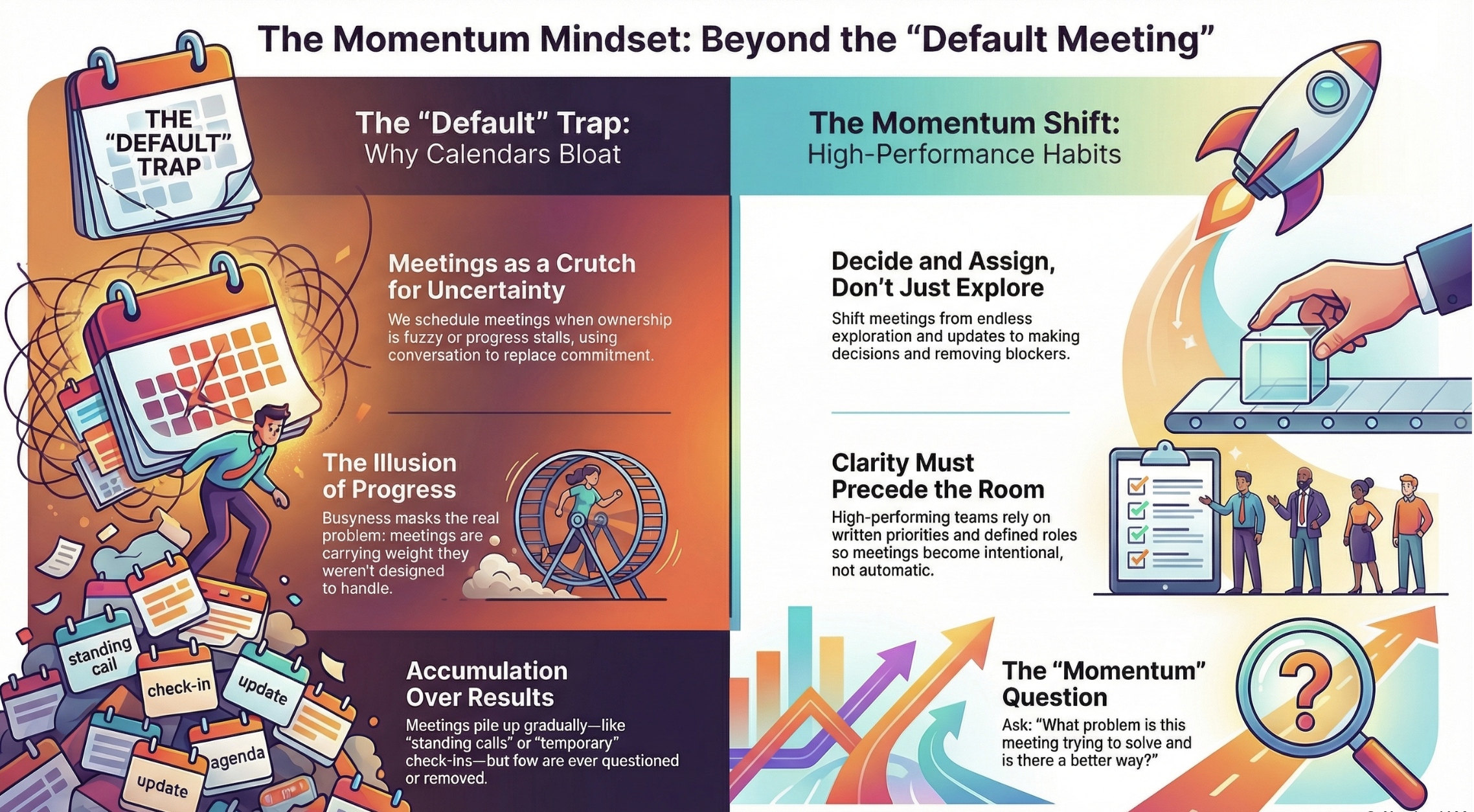
Meetings Accumulate Faster Than Results
Teams don’t usually design bloated calendars on purpose. Meetings pile up gradually:
A recurring meeting that used to be useful
A check-in added “just for this quarter”
A standing call created because one decision once took too long
Each one makes sense individually. But few of them get questioned once they’re on the calendar. The result is that teams collect meetings that feel important, but don’t reliably produce clear decisions, ownership, or real movement.
Execution slows down even though the calendar fills up.
Meetings Become a Substitute for Clarity
The core issue isn’t time. It’s clarity. Meetings usually fill in where other leadership tools are missing.
Without clear decision rights, written priorities, and defined next actions, meetings become the place where we talk about work instead of moving work forward. Conversation replaces commitment. Alignment replaces action.
And because uncertainty feels uncomfortable, meetings feel productive, even when nothing actually changes afterward.
Busyness Masks the Real Problem
A full calendar creates the illusion of progress. Everyone is busy and involved. But involvement is not ownership, and discussion is not execution.
This is why teams can work harder, meet more often, and still feel stuck. The problem isn’t effort, it’s that meetings are carrying weight they were never designed to carry.
Fewer Meetings Isn’t the Goal
The answer isn’t as simple as “have fewer meetings.” They key is changing what meetings are for.
High-performing teams use meetings to:
Decide, not explore endlessly
Assign owners, not just agree in principle
Remove blockers, not create updates
They rely less on meetings because clarity exists before people get in the room.
When roles are clear, priorities are written, and follow-through is expected, meetings stop being the default. They become a tool used intentionally, not automatically.
Rather than asking, “Do we need this meeting?” the real question is “What problem is this meeting trying to solve and is there a better way to solve it?”.
If the answer is clarity, alignment, or accountability, the solution may not be another hour on the calendar. It may be getting some clarity on who owns what and what’s getting in the way of progress.
The goal is momentum, not just a lighter calendar.