If You’re Scaling, Your Team’s Accountability Is at Risk
What starts to feel off isn’t accountability itself. It’s how hard it becomes to talk about it, and most leaders don’t notice that shift until conversations that used to feel simple start carrying weight they didn’t before.
The team is still working hard and people are still showing up. Output is still happening, but there’s this quiet sense that the bar isn’t as clear as it used to be, even though no one can point to when it changed.
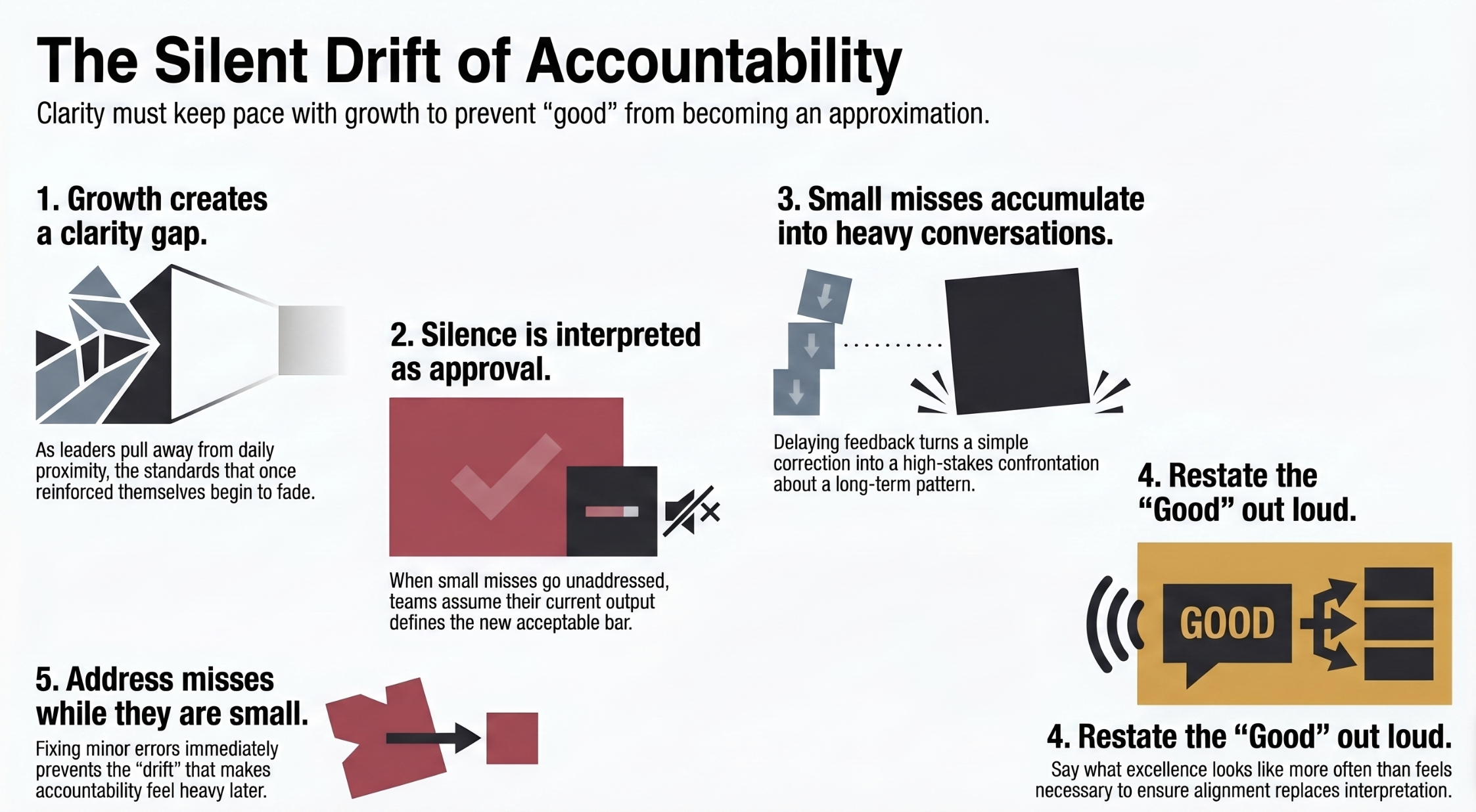
Early on, everything runs through proximity. You don’t have to define much because everyone is close enough to feel what “good” looks like, and when something is off it gets addressed in real time, often in passing, without turning into a formal conversation.
Then the company grows, and nothing obvious breaks. But leaders get pulled into things that feel more strategic, managers inherit more people, and decisions start happening further away. The same standards that used to reinforce themselves now depend on someone choosing to restate them, and that choice gets made less often than people think.
At the same time, the work usually speeds up. And when pressure increases, teams start prioritizing speed in ways that slowly reshape what acceptable looks like. Because everyone is busy and contributing, it doesn’t immediately register as drift.
Where it starts to show up is in the assumptions underneath it. Leaders tend to believe expectations are still obvious, while teams tend to believe they’ll hear about it if something isn’t working, and those two things can sit side by side for a long time without friction until they don’t.
Silence starts to replace feedback. And silence almost always gets interpreted as things being fine.
So small misses go unaddressed. And because they go unaddressed, they repeat. Over time, what used to be a clear standard turns into something people are approximating instead of aiming for.
By the time it gets addressed, it rarely feels like a small correction. It feels like a conversation about a pattern, and that’s where the tone shifts, because the leader isn’t reacting to one instance, they’re reacting to accumulated frustration, and the person on the receiving end experiences it as something sudden.
And that’s when leaders start to feel like accountability itself has gotten harder, when what actually happened is that clarity stopped keeping pace with everything else that was scaling.
The standards didn’t disappear. They just stopped being reinforced at the rate the organization needed, which changes how people interpret them, and once interpretation replaces alignment, every performance conversation starts carrying more weight than it should.
So when accountability feels like it’s slipping, what you’re usually seeing is a team that has moved further away from the conversations that used to keep things tight, and closer to a version where everyone is doing their best inside slightly different definitions of what good actually means.
And the leaders who catch it early don’t do anything dramatic, they just start pulling things back into the open again.
They say what good looks like out loud, more often than feels necessary, because they know what feels repetitive to them is usually the first time someone else is hearing it clearly.
They address small misses when they’re still small, even when it feels easier to let it go, because they’ve learned that what feels like saving time in the minute usually shows up later as a heavier conversation they didn’t need to have.
And they stop assuming alignment just because no one is pushing back, and instead they check for it in how decisions are being made and how work is actually getting done, which usually tells the truth faster than any meeting will.
None of that feels like a big move while you’re doing it. It doesn’t create immediate change, but it quietly tightens the system again in a way that makes accountability feel lighter, which is usually how you can tell it’s working even before the results show up.