Your Business is a Narcissist
There’s something I keep seeing among teams that nobody says out loud, probably because it sounds a little strange the first time you hear it. And once you see it, you can’t unsee it.
Businesses behave like narcissists.
Not you. Not your leadership team. The company itself, as an entity.
When most people hear narcissist, they think vanity. That’s not what I mean. Clinically, narcissism is a specific pattern: an insatiable need for resources and attention, an inability to tolerate limits, a habit of creating chaos when those limits get set, and a complete indifference to the wellbeing of the people serving it. It extracts. It doesn’t reciprocate. It doesn’t remember what you gave it last quarter. It only knows what it needs right now.
Sound familiar?
The business needs cash, constantly. It needs decisions, attention, energy, focus. When it’s growing, it needs more of all of it. It doesn’t ask. It takes. And it has this almost supernatural ability to manufacture urgency that overrides everything else, including your judgment, your health, and frankly your life outside the building.
A narcissist creates an environment where the people closest to them reorganize their lives around managing the narcissist’s demands.
They stop expressing their own needs. They stop having expectations. They get skilled at absorbing the chaos before it becomes visible. They become the buffer.
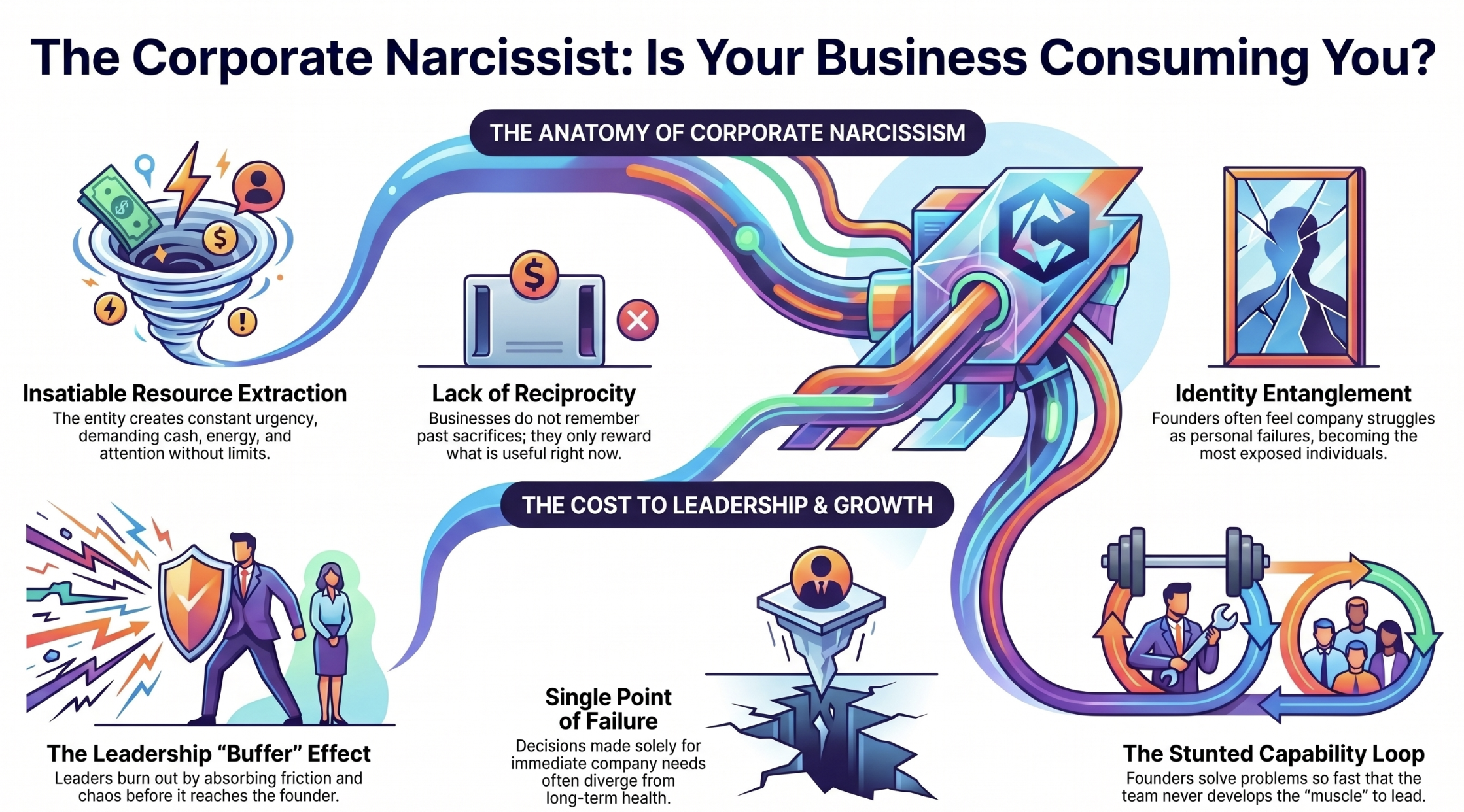
Now look at your leadership team under pressure. What you’re watching is exactly that. Every leader in the room has gotten good at managing up to the company’s demands, catching the friction before it lands somewhere worse, keeping things moving because the alternative is a crisis.
They’re good at it. They’re probably even your A players. That’s why they’re still there. But good at absorbing friction isn’t the same as thriving, and eventually the capacity runs out. When it does, they don’t tell you. They go quiet, or they leave, or they burn out in place. None of those things announce themselves clearly before they happen.
The founder is the most exposed. The business has a claim on you that nothing else in your life does. It came from you. The identity entanglement is total. When the company needs something, you feel it before you’ve even processed it. When it struggles, it registers as personal failure. When it wins, you’re relieved, not satisfied, because you already know what it’s going to need next.
I’m not saying this is a character flaw. This is what happens when you’ve built something real and that something is genuinely dependent on you. But the dynamic doesn’t stay constant. It compounds.
The founder who can’t separate their own condition from the business’s condition becomes a single point of failure. Decisions get made through the filter of what the company needs right now rather than what’s right for it long-term, and those two things can diverge quickly. You’ve probably already felt that tension.
The company doesn’t reward the people who serve it well. It rewards whoever is most useful to it at this moment. Loyalty doesn’t register. History doesn’t register. It’ll take what the next person is offering without acknowledging what you gave it.
The hardest part of this pattern is that it's self-reinforcing in a way that makes it invisible from inside. The business needs you because you're the most capable person in it. You're the most capable person in it partly because the business has never been designed to develop capability anywhere else. You solve problems faster than the team does, so you solve them. Because you solve them, the team never has to develop the muscle. Because the team doesn't have the muscle, you have to solve them. Round and round you go.
You already know this. You’ve watched good people leave and understood why even when it hurt.
So what do you do about it?
The first thing (and I know this is harder than it sounds) is to stop treating the company as something that deserves your emotional loyalty. It’s a system. Systems don’t have feelings. They have requirements. Those requirements should be managed, not honored.
Most founders I work with can say that sentence and agree with it and still not be able to act on it, because the entanglement runs deeper than logic.
The second thing is to create some real distance between your identity and the company’s condition. Not indifference, but distance. Enough separation to think clearly when it’s under pressure. The founder who can watch the business struggle without experiencing it as personal failure makes better decisions and makes them faster. They’re not detached, they’re just not flooded, and that’s a valuable distinction.
The third thing is where the structural work comes in. The company will take everything you make available. That’s not going to change. So the question isn’t how to give more, it’s how to redesign the system so it doesn’t require this level of your resources in the first place. That means building operations that don’t need you in the middle of every decision. It means developing leaders who own outcomes rather than manage friction. It means looking honestly at where the company’s demands are genuinely necessary and where they’re a function of friction you’ve normalized so thoroughly you stopped noticing it.
The businesses that get out of this pattern aren’t the ones where the founder eventually out-disciplines the situation. They’re the ones where someone stopped and looked at the system clearly and changed it so the same battles don’t have to be fought every day.
You built something that works.
The question you might want to consider is whether it works for you, or whether you’ve slowly become the primary resource it runs on.